Why Bamboo
Environmental Benefits
Rapid Growth
Soil Erosion Control
Biodiversity
Water Conservation
Economic Benefits
Income Generation
Versatile Products
Job Creation
Cost-Effective
Social Benefits
Community Empowerment
Cultural Heritage
Affordable Housing
Sustainable Development
Renewable Resource
Waste Reduction
Environmental Benefits
Rapid Growth
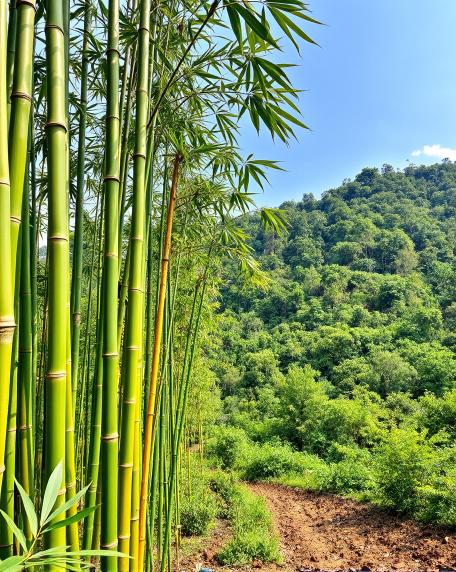
Bamboo thrives in Malaysia’s tropical climate, where its rapid growth can help with reforestation and carbon sequestration efforts. Its ability to grow quickly aids in combating climate change by absorbing CO2 and releasing oxygen.
Soil Erosion Control
Extensive root system prevents soil erosion and stabilizes slopes.
Biodiversity
Supports local wildlife and maintains ecological balance.
Water Conservation
Requires less water compared to other crops.
Economic Benefits
Income Generation
Versatile Products
Job Creation
Cost-Effective
Sustainable Development
Renewable Resource
Waste Reduction
Bamboo and Carbon Removal Credits in Malaysia
At Terra Bamboo, we are dedicated to obtaining carbon removal credits through our bamboo cultivation efforts. By leveraging bamboo’s rapid growth and its ability to absorb significant amounts of CO2, we contribute to reducing greenhouse gases and combating climate change. Our process involves precise measurement and verification of the CO2 absorbed by our bamboo, ensuring that we meet the standards set by certification bodies such as MyCREST and international standards like the Verified Carbon Standard (VCS). These carbon removal credits not only enhance our environmental impact but also provide an additional revenue stream and incentivize the adoption of sustainable cultivation practices.
Our Products
Dendrocalamus Asper (Buluh Betong)
At Terra Bamboo, we specialize in Dendrocalamus Asper, also known as Buluh Betong. Which is known for its size, strength, and versatility. This giant bamboo can reach heights of 30 meters and diameters of 20 centimeters, making it ideal for:
Construction Materials
Applications
Dendrocalamus Asper’s unique properties make it suitable for a wide range of uses across various sectors:
- Construction Materials
- Elegant Furniture
- Innovative Crafts
- Eco-Friendly Packaging
Our Services
Planters Program
Join our Planters Program to make a tangible difference in the environment. For a modest fee, you can plant a bamboo tree and contribute to expanding green spaces. Your support helps nurture new bamboo forests and enhances biodiversity.
Join us in our mission to make a positive impact
through sustainable bamboo cultivationand be a part of a movement toward a more sustainable world.

SDG 2 - Zero Hunger
Bamboo shoots are highly nutritious and widely enjoyed in Asia. As a valuable byproduct, they have played a key role in the bamboo industry for many years. Since bamboo can grow well on degraded land, cultivating it does not take away space from land used for important food crops.
SDG 8 – Decent Work and economic growth
We believe bamboo farms and related industries can revitalize agriculture and establish a strong bamboo processing industry. In Asia and Malaysia, bamboo is used in diverse sectors, from simple products to advanced applications in pharmaceuticals and technology. Bamboo farming creates jobs, revitalizes rural areas, and encourages young people to return to these communities.
SDG 9 – Industrial innovation and infrastructure
Our business model focuses on circularity, nature-inclusivity, and innovation. Beyond the traditional uses of bamboo, its fibers and wood serve as excellent alternatives to tropical hardwood and high-tech composite materials. We collaborate with universities, research centers, and innovative companies, with special attention to developing unique products from bamboo grown across Asia.
SDG 11 – Sustainable cities and communities
In Asia, bamboo is widely used as a sustainable material for urban development, with China recognizing it as key to green growth. From construction to composite materials, bamboo supports sustainable cities and fits into a circular economy. It also absorbs more carbon, produces more oxygen, retains water, and aids in soil sanitation compared to traditional crops or trees.
SDG 12 – Responsible consumption and production
Bamboo is an efficient, zero-waste crop that only needs planting once every 60 to 100 years and uses minimal water. It develops its own water management system, aiding soil regeneration. We prioritize low energy consumption, using solar power and gravity-based irrigation systems with minimal energy. A sustainable bamboo industry is both profitable and environmentally beneficial.
SDG 13 – Climate action
Bamboo is the fastest-growing grass, with year-round leaves, making it a leader in carbon sequestration. It absorbs significantly more carbon dioxide than traditional trees and produces substantially more oxygen. Managed bamboo forests are highly efficient at storing carbon, with the ability to store up to 1.6 tonnes of CO2 per cubic meter. Cultivating bamboo in Malaysia for local markets helps reduce the carbon footprint associated with transporting it from other areas.
SDG 15 – Life on Land
Bamboo thrives on eroded or degraded land, restoring soil fertility through its root system. It creates its own ecosystem and water management system, attracting diverse wildlife. Well-managed bamboo fields are not invasive, as they rarely produce seeds and their running roots can be easily controlled. Bamboo grows well alongside other crops, is pesticide-free, and requires no tillage. Its year-round leaf fall enriches the soil with a thick humus layer.
SDG 17 – Partnerships for the goals
We believe the sustainable bamboo industry in Malaysia can revitalize agriculture and tap into a growing market for bamboo products. Demonstrating the benefits of bamboo to individuals, businesses, and governments is crucial. Cross-border cooperation and financial support are essential for bamboo to become a new agricultural segment. We are committed to joint ventures and research collaborations and welcome companies interested in exploring bamboo as an alternative raw material, as there is significant interest in its potential.
Social Benefits
Community Empowerment
Cultural Heritage
Affordable Housing
Provides a sustainable material for building homes.